

To-sun Technology · News Trends
Invite you to witness every step of development and growth
AliCPT-1, Listening to the "First Cry of a Baby" from 13.8 Billion Years Ago
Release time:
2025-08-26 14:10
Ripples of Spacetime — Primordial Gravitational Waves
The mainstream theory of modern cosmology holds that the universe underwent an extremely brief but extraordinarily rapid expansion phase in its very early moments — cosmic inflation, during which the scale of the universe expanded by a factor of a quintillion in a trillionth of a second. This intense process not only planted the "seeds" for the later formation of cosmic structures such as galaxies and galaxy clusters but also stirred ripples in spacetime — the primordial gravitational waves.
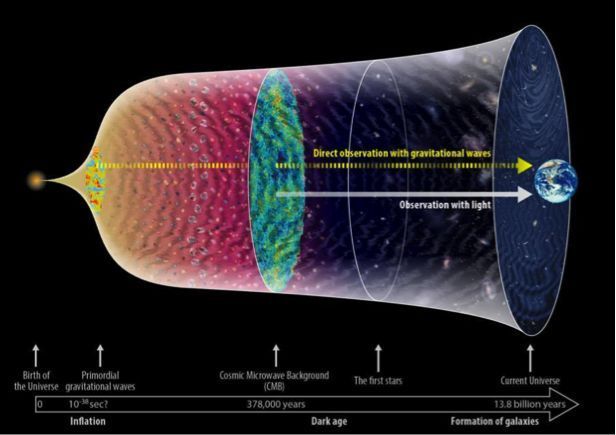
△Detecting Primordial Gravitational Waves, Tracing Early Cosmology
Gravitational waves are fluctuations in spacetime. In 2015, the Laser Interferometer Gravitational-Wave Observatory (LIGO) collaboration announced the first detection of gravitational waves, a groundbreaking discovery that won the Nobel Prize in Physics and ushered in a new era of gravitational wave astronomy. The dozens of gravitational wave detections accumulated so far have all originated from massive celestial bodies, such as mergers of black holes and neutron stars. Primordial gravitational waves are entirely different; they were generated by quantum fluctuations of spacetime 13.8 billion years ago and are called "the first cry of the cosmic baby." To this day, these faint ripples still echo throughout the universe.
Primordial gravitational waves carry the core secrets of the universe's birth. Modern cosmology proposes various possible scenarios for the very early universe, such as: the inflationary universe — where the universe underwent an exponential ultra-rapid expansion shortly after its birth; the bouncing universe — where the universe rebounded after a contraction; the cyclic universe — where the universe undergoes repeated cycles of expansion and contraction. Different theoretical models predict different mechanisms and intensities for the generation of primordial gravitational waves. Therefore, detecting the existence of primordial gravitational waves and measuring their intensity is like obtaining the key to unlocking the mysteries of the universe's birth. Moreover, primordial gravitational waves are direct evidence that quantum fluctuations of spacetime were amplified by inflation to observable scales. Detecting them would mark humanity's first observation of quantum effects of gravity, providing strong evidence for the existence of gravitons and relating to the very nature of spacetime.
After 13.8 billion years, primordial gravitational waves have become extremely weak. Fortunately, people can search for traces of primordial gravitational waves through the afterglow of the Big Bang, namely the Cosmic Microwave Background (CMB) radiation — specifically the primordial B-mode polarization. This large-scale, swirling polarization pattern is like the "fingerprint" left by primordial gravitational waves on the CMB "film" and is one of the most direct pieces of evidence for their existence. Laser interferometers like LIGO detect gravitational waves by acting like a "spacetime video recorder," recording real-time changes in arm length caused by gravitational waves; in contrast, CMB polarization telescopes detect primordial gravitational waves more like taking a "fossil photograph" from the early universe.
Providing a Constant Temperature Environment for AliCPT-1
During the first five years of the Ali project (2016–2021), efforts focused on the construction, observation, and related scientific research of the Ali CMB Polarization Telescope-1 (AliCPT-1). AliCPT-1 is a 72cm aperture CMB polarization telescope with two frequency bands, 95GHz and 150GHz, and is currently an internationally leading CMB polarization telescope.

△Overall View of the Telescope and Base
The AliCPT-1 telescope detects primordial gravitational waves by precisely measuring the CMB B-mode polarization angular power spectrum at an angular scale of about 2 degrees (CMB multipoles distributed roughly between l~50 and 300). Theoretically, the primordial BB spectrum formed during the early universe's recombination process has the strongest signal at this scale, and at this scale, the B-mode polarization signal caused by CMB lensing is not dominant. Therefore, conducting precise measurements of the BB angular power at the 2-degree scale provides an excellent window for detecting primordial gravitational waves. The AliCPT-1 telescope targets the recombination peak around l~100 for precise measurements to detect primordial gravitational waves.

△Theoretical Model Predictions of T, E, and B Mode Power Spectra
Detecting primordial gravitational waves requires extremely stringent site conditions. Water vapor in the atmosphere severely interferes with the precise measurement of such weak polarization signals. Generally, sites with a median precipitable water vapor content below 2 millimeters during the observation season are considered ideal. Globally, only the South Pole in Antarctica, the Atacama Desert in Chile, Greenland, and the Ali region of Tibet in China meet such conditions. In winter, the Ali site temperature can drop to minus 30 degrees Celsius, with median precipitable water vapor content below 1 millimeter during the observation season. Of course, such an environment is still far from sufficient.
Nanjing Expansion Technology Co., Ltd. is responsible for constructing the Ali-1 observation cabin project, which is also the installation site of the Ali Primordial Gravitational Wave Telescope (AliCPT-1). To ensure a stable constant temperature environment inside the observation cabin, the company customized an automatic heating control service system for the project. This system can automatically and precisely control environmental parameters, including temperature, humidity, and pressure difference, providing stable and reliable precise control for the No. 1 observation cabin.
[Click here to view project case details]
In April 2025, at an altitude of 5250 meters on the Ali Plateau in Tibet, China's Ali Primordial Gravitational Wave Detection Experiment (AliCPT) successfully achieved "first light" observation.
The first phase of the Ali Primordial Gravitational Wave Detection Experiment (AliCPT-1) has the largest effective aperture and can carry the most detectors among similar international telescopes. Currently, AliCPT-1 has entered the scientific observation phase and will continue scanning for several years, searching for the unique imprint of primordial B-modes in the CMB polarization signal. The exploration of primordial gravitational waves will reveal the universe's most primordial appearance, allowing us to "listen" to echoes from 13.8 billion years ago.
Some content sourced from: People's Daily (August 23, 2025, Page 06)
Related News

Committed to becoming a leader in the field of laboratory construction in China

WeChat Public Number
Nanjing To-Sun Technology Co.,Ltd
sale@to-sun.com
Address: 6th Floor, Anke Building, 31 Guangju Road, jianye district, Nanjing