

To-sun Technology · News Trends
Invite you to witness every step of development and growth
Comprehensive Analysis of Battery Laboratory Construction: Building an Industry-Leading Research Platform
Release time:
2025-09-12 10:21
In the current booming development of the new energy industry, battery technology, as the core driving force, has become increasingly important in research and innovation. As the cradle for nurturing cutting-edge technology and promoting industrial upgrading, how to scientifically and efficiently build a battery laboratory has become a focus of industry attention. This article by Nanjing Expansion Technology will combine previous battery laboratory construction cases to deeply analyze the key aspects of battery laboratory construction, presenting you with a comprehensive and professional construction guide.
1. Clarify Construction Goals and Positioning
Before starting the construction of a battery laboratory, the primary task is to clarify its construction goals and positioning. This not only concerns the future research direction of the laboratory but also determines its status and influence in the industry. For example, if the focus is on the research and development of new battery materials, then the laboratory's equipment configuration, talent reserve, and research strategies should revolve around this core goal; if positioned for battery system integration and optimization, emphasis should be placed on system testing, compatibility research, and other capability building. Clear goals and positioning are the cornerstone of battery laboratory construction, providing clear directional guidance for subsequent work.
2. Reasonable Site Selection and Space Planning
(1) Key Points for Site Selection
The site selection for a battery laboratory must comprehensively consider multiple factors. First, it should be far from residential areas, main traffic routes, and noise sources to ensure a quiet and safe experimental environment. At the same time, the surrounding infrastructure support, such as stable power supply and complete water supply and drainage systems, should be considered. In addition, geological conditions should not be overlooked; areas prone to earthquakes or geologically unstable regions should be avoided to prevent potential threats to experimental equipment and personnel safety.
(2) Principles of Space Planning
- Clear functional zoning: The laboratory should be reasonably divided into different functional areas such as experimental zones, office areas, sample storage areas, and waste disposal zones. The experimental area can be further subdivided into cell preparation zones, battery testing zones, material analysis zones, etc. Each area should remain relatively independent to avoid mutual interference. For example, the cell preparation area requires a high level of cleanliness and should be isolated from dust-generating areas; the battery testing area needs to consider equipment heat dissipation and noise issues, arranging space reasonably.
- Smooth personnel and logistics channels: Design clear and reasonable personnel and logistics pathways to ensure efficient flow of people and materials. Personnel pathways should be spacious and comfortable, meeting emergency evacuation requirements; logistics channels should be planned according to the size and weight of experimental equipment and samples, with appropriate width and load-bearing capacity. At the same time, avoid crossing of personnel and logistics flows to reduce contamination and safety hazards.
- Reserve development space: Considering the rapid development of battery technology and the future business expansion needs of the laboratory, certain expandable space should be reserved during space planning. This not only provides placement for new experimental equipment and research projects but also accommodates personnel expansion due to laboratory scale growth, ensuring good sustainable development capability of the laboratory.
3. Advanced Equipment Configuration and Selection
(1) Core Equipment List
- Battery manufacturing equipment: including mixers, coating machines, rolling machines, stacking machines, winding machines, filling machines, etc. These devices are key tools for cell preparation, and their performance directly affects battery quality and performance. For example, high-precision mixers ensure uniform mixing of battery materials, thereby improving battery consistency and stability; advanced coating machines can achieve precise control of coating thickness, laying the foundation for improving battery energy density.
- Battery testing equipment: covering battery performance testers, charge-discharge testing systems, cycle life testing equipment, safety performance testing devices, etc. Battery performance testers measure basic parameters such as capacity, voltage, and internal resistance; charge-discharge testing systems simulate the charging and discharging process under different conditions to evaluate efficiency and cycle performance; safety performance testing devices like nail penetration testers, crush testers, and overcharge/overdischarge testers are used to detect battery safety under extreme conditions, ensuring safe use.
- Material analysis equipment: including X-ray diffractometers (XRD), scanning electron microscopes (SEM), Fourier transform infrared spectrometers (FT-IR), etc. These devices are used for in-depth analysis of battery material structure, morphology, and composition, providing strong support for material research and optimization. For example, XRD can accurately determine crystal structure and lattice parameters, helping researchers understand phase transitions and crystal defects; SEM provides direct observation of microscopic morphology, revealing surface features and internal structure.
(2) Equipment Selection Principles
- Excellent performance: prioritize equipment with stable performance, high precision, and strong reliability. In battery R&D, the accuracy of experimental data is crucial, so equipment must have outstanding measurement accuracy and repeatability to ensure the credibility of results. For example, when selecting battery charge-discharge testing equipment, attention should be paid to voltage and current measurement accuracy and constant current/constant voltage control precision.
- Compatibility and scalability: consider compatibility between devices to ensure different equipment can work collaboratively, forming a complete experimental testing system. At the same time, equipment should have certain scalability, able to meet future experimental needs through upgrades or adding modules. For example, some advanced material analysis devices can expand functions by adding different detectors or accessories.
- Compliance with standards and regulations: equipment selection should strictly follow relevant domestic and international standards and regulations, such as the International Electrotechnical Commission (IEC), Underwriters Laboratories (UL), and Chinese National Standards (GB). This not only helps ensure comparability and authority of experimental results but also meets product certification and market access requirements. For example, equipment used for battery safety performance testing must comply with corresponding safety standards to guarantee safety and validity of testing.
4. Strict Environmental Control and Assurance
(1) Temperature and Humidity Control
Batteries are extremely sensitive to temperature and humidity; even slight environmental changes can significantly affect their performance and lifespan. Therefore, battery laboratories must be equipped with high-precision temperature and humidity control systems, combined with battery laboratory projects previously undertaken by Nanjing Expansion Technology Co., Ltd. to explain. The project precisely controls temperature within ±0.5°C, and the air dew point inside the battery laboratory is required to be below -60°C. This usually requires the use of constant temperature and humidity air conditioning systems combined with temperature and humidity sensors for real-time monitoring and regulation to ensure environmental stability.
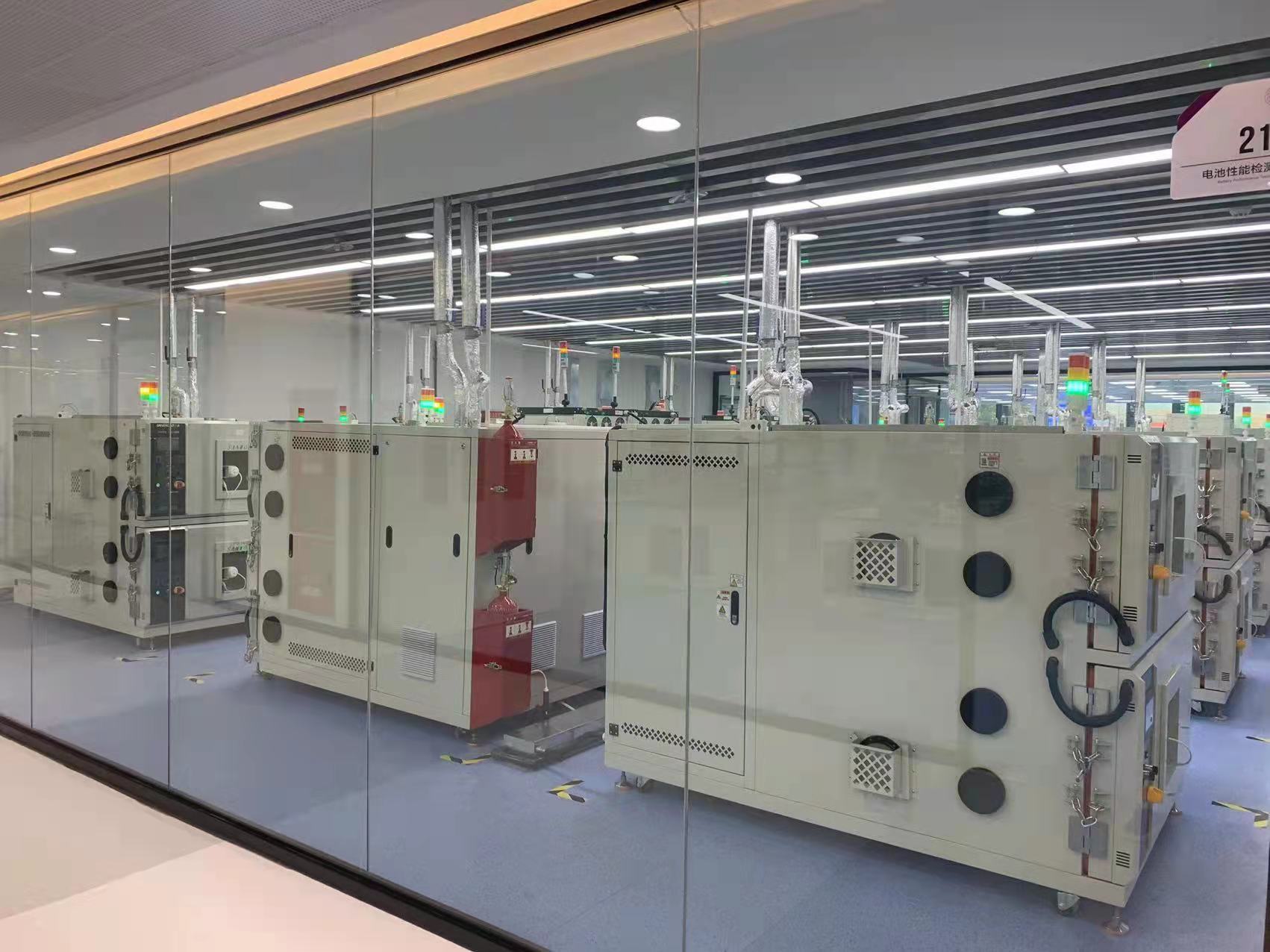
(2) Cleanliness Requirements
To prevent dust, particles, and other impurities from contaminating battery materials and cells, thereby affecting battery performance, the laboratory must maintain a certain level of cleanliness. Projects commonly encountered by Nanjing Expansion Technology typically require Class 1000 or Class 100 cleanroom standards. For critical areas such as battery cell preparation, cleanliness standards usually need to reach Class 10,000 or even higher. This can be achieved by installing high-efficiency particulate air (HEPA) filters, using cleanroom construction materials, and establishing strict personnel and material purification procedures. For example, personnel entering the clean area must wear cleanroom suits and pass through air showers for purification; materials must also be purified through pass-through windows before entry.
(3) Ventilation and Exhaust Gas Treatment
During experiments, various harmful gases and exhaust fumes are generated, such as organic waste gases from the volatilization of organic solvents and acidic or alkaline exhaust gases produced during battery charging and discharging. To ensure the health of laboratory personnel and environmental safety, the laboratory must establish a comprehensive ventilation and exhaust gas treatment system. The ventilation system should ensure timely air exchange indoors to maintain fresh air; the exhaust gas treatment system should purify exhaust gases according to their nature using appropriate treatment processes such as adsorption, combustion, and scrubbing, ensuring that emissions meet national discharge standards before release.
(4) Electromagnetic Shielding and Anti-Static Measures
Some precision testing equipment in battery experiments is sensitive to electromagnetic interference, and battery materials and cells can easily generate static electricity during preparation, which may damage the batteries. Therefore, the laboratory must implement effective electromagnetic shielding and anti-static measures. Electromagnetic shielding can be achieved by designing the laboratory with overall shielding, using shielding materials to construct walls, doors, and windows; anti-static measures include laying anti-static flooring, installing anti-static grounding systems, requiring personnel to wear anti-static work clothes and anti-static wristbands to eliminate static hazards.
5. Formation of a Professional Talent Team
(1) Talent Demand Analysis
The construction and operation of a battery laboratory require a multidisciplinary professional team covering fields such as materials science, electrochemistry, mechanical engineering, and electronic engineering. Specifically, researchers with battery material R&D capabilities are needed to synthesize, characterize, and optimize new materials; engineers proficient in electrochemical principles to design, test, and analyze batteries; and technical personnel familiar with mechanical and electronic engineering to maintain, debug, and automate experimental equipment.
(2) Talent Training and Recruitment Strategies
- Internal Training: Establish a comprehensive internal training system to provide employees with continuous learning and development opportunities. Regularly organize internal technical exchange seminars, invite industry experts for technical lectures, and encourage employees to participate in domestic and international academic conferences and training courses to broaden their knowledge and technical horizons. Additionally, set up an internal mentorship system where experienced senior staff provide one-on-one guidance to new employees to help them grow quickly.
- External Recruitment: Actively recruit high-level talents with rich experience and professional skills from universities, research institutions, and industry enterprises. By offering competitive salaries, a good working environment, and broad development opportunities, attract outstanding talents to join the laboratory team. Furthermore, establish industry-academia-research cooperation with universities and research institutions to introduce excellent reserve talents through joint training of graduate students and postdoctoral researchers.
6. Quality Control and Safety Management
(1) Quality Control System Construction
Establishing a comprehensive quality control system is key to ensuring the accuracy and reliability of experimental results in the battery laboratory. This includes formulating strict standard operating procedures (SOPs) to standardize every step of the experimental process; establishing experimental data recording and review systems to ensure data authenticity, completeness, and traceability; regularly calibrating and maintaining experimental equipment to ensure optimal performance; conducting internal quality audits and management reviews to promptly identify and correct issues in the quality system operation.
(2) Safety Management Measures
- Safety Facility Equipment: The laboratory should be equipped with complete safety facilities such as fire alarm systems, fire extinguishing equipment, emergency showers, eye wash stations, and explosion-proof electrical appliances. Safety exits and evacuation routes should be reasonably arranged and kept unobstructed. For example, in areas prone to fire such as battery testing zones, smoke and temperature sensors should be installed and linked to the fire alarm system to provide early fire warnings; in areas using hazardous chemicals, emergency showers and eye wash stations should be set up to promptly wash and treat personnel in case of accidents.
- Hazardous Chemical Management: Battery experiments involve various hazardous chemicals such as lithium salts, organic solvents, strong acids, and bases. A strict hazardous chemical management system must be established to control the procurement, storage, use, and disposal of hazardous chemicals throughout the process. Hazardous chemicals should be stored in dedicated cabinets and classified according to their properties to avoid reactions that could cause safety incidents. During use, laboratory personnel must strictly follow operating procedures and wear appropriate protective equipment to ensure safety.
- Personnel Safety Training: Strengthen safety training for laboratory personnel to enhance their safety awareness and emergency response capabilities. Safety training should cover laboratory safety regulations, safe use of hazardous chemicals, operation of firefighting equipment, and emergency escape skills. Regular safety drills should be organized to allow personnel to practice emergency responses in simulated scenarios, familiarize themselves with emergency procedures, and improve their ability to handle unexpected incidents.
The construction of a battery laboratory is a complex and systematic project that requires comprehensive consideration and meticulous development from clarifying construction goals, reasonable site selection and space planning, advanced equipment configuration, strict environmental control, professional talent team formation, to strengthening quality control and safety management. Only by doing so can a technologically advanced, fully functional, safe, and reliable battery laboratory be built, providing a solid support platform for the innovative development of battery technology and helping the new energy industry move towards a more brilliant future.
Related News

Committed to becoming a leader in the field of laboratory construction in China

WeChat Public Number
Nanjing To-Sun Technology Co.,Ltd
sale@to-sun.com
Address: 6th Floor, Anke Building, 31 Guangju Road, jianye district, Nanjing