

To-sun Technology · News Trends
Invite you to witness every step of development and growth
Key Points for HVAC Design in PCR Laboratories
Release time:
2025-08-19 15:06
With the rapid development and wide application of biotechnology, the importance of PCR laboratories is becoming increasingly prominent. In PCR laboratories, it is necessary not only to prevent the leakage and spread of harmful biological factors, but also to provide suitable and stable environmental conditions for experimental operations, such as precise temperature, humidity, pressure gradient, and clean air quality. Therefore, in-depth research biosafety laboratory HVAC system design is of great significance for promoting the safe and orderly development of bioscience research and ensuring ecological environment and public health. Therefore, this article discusses several design points of the PCR laboratory HVAC system for reference by relevant practitioners.
The PCR biosafety laboratory is an important place for conducting research and testing of pathogenic microorganisms. The stability and safety of its internal environment are crucial for ensuring the health of laboratory personnel and the reliability of experimental results. As the core facility for maintaining laboratory environmental conditions, the HVAC system must not only provide a comfortable working environment, but also effectively control the spread and cross-contamination of pathogens.
I. Requirements for HVAC System Design in Biosafety Laboratories
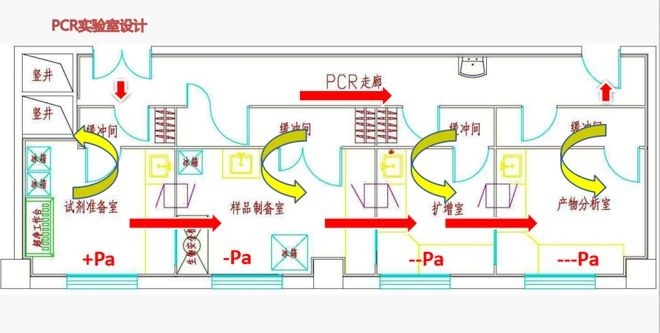
PCR laboratories are basically BSL-2 or BSL-2+ (enhanced laboratory) level laboratories. According to the specifications: temperature: 18-27℃, humidity: 30-70%, noise ≤60dB (A), cleanliness can be level 8 or level 7, or no clean design is required, without mandatory requirements. The pressure difference and cleanliness are determined according to process requirements. Generally, the reagent preparation room is positive pressure, and other laboratories are negative pressure environments: the pressure decreases in the order of the process experiment flow.
The following table is for reference:
| Type |
PCR laboratory |
|||
| Name pressure difference |
Area 1 |
Area 2 |
Area 3 |
Area 4 |
| Buffer +5Pa |
Buffer -5Pa |
Buffer -5Pa |
Buffer -5Pa |
|
| Reagent preparation +10Pa |
Sample preparation -10Pa |
Product amplification -20Pa |
Product analysis -30Pa |
|
| Description |
Workflow -------→ |
|||
Note: The pressure difference value is the relative pressure difference value to the outdoor atmospheric pressure.
The design of the PCR laboratory HVAC system follows three principles: safety principle: reasonable airflow organization, stable pressure difference gradient in each functional area, preventing the leakage of biological factors and the spread of polluted air; functional principle: meeting the temperature, humidity, and cleanliness requirements of the laboratory; scientific principle: based on the requirements of the specifications, the design is reasonable and complies with relevant specifications, ensuring the smooth progress of gene amplification experiments.
II. Design Points of HVAC System in Biosafety Laboratories
(1) Design of Air Change Rate, Supply Air Volume and Exhaust Air Volume
PCR laboratories should use a fresh air conditioning unit for centralized air supply and separate exhaust air in each functional area to prevent cross-contamination.
The supply air volume is based on the largest of the following calculated values:
Clean air volume: The cleanliness requirement is When level 7 (10,000 level), the number of air changes needs to meet 15-25 times/h, and when level 8 (100,000 level), the number of air changes needs to meet 10-15 times/h. Generally, the upper limit is taken when conditions permit.
Load air volume: calculated according to the indoor heat load, mainly including the heat dissipation of the envelope structure, equipment, personnel, etc., of which equipment, personnel, etc. need to be provided by the process. Designers calculate the air volume based on the total heat load, temperature, humidity and other indicators.
When the supply air volume is determined, the exhaust air volume can be calculated according to the pressure difference air volume.
The pressure difference air volume is calculated according to the number of air changes method, generally according to each 5Pa pressure difference takes 1-2 times/h air change rate (can take 1.5 times/h), or the gap method can also be used. The room supply air volume needs to meet the requirements of removing indoor heat and humidity load and cleanliness, and the larger of the two is taken, and then the corresponding exhaust air volume is calculated according to the pressure difference. For example, if the load air volume of a room is 1500m³/h, the clean air volume is 2000m³/h, and the pressure difference air volume calculated by the pressure difference is 300m³/h, then the indoor supply air volume should be the larger value of the load air volume and the clean air volume, 2000m³/h. When the room is positive pressure, the exhaust air volume should be 1700 m³/h; when the room is negative pressure, the exhaust air volume should be 2300m³/h.
(2) Reliable pressure control
Different areas should be set with different pressure values according to the risk level. The clean area has the highest pressure and the contaminated area has the lowest pressure. A certain pressure difference should be maintained between adjacent areas. The specific pressure can be based on the pressure reference table. Pressure control can be achieved through an automatic control system, which monitors the pressure in each area in real time and maintains a stable pressure difference through quantitative air supply and variable air exhaust, and sets up a pressure alarm device.
When the laboratory is opened, the positive pressure laboratory first turns on the supply fan, and then turns on the exhaust fan. The negative pressure laboratory first turns on the exhaust fan, and then turns on the supply fan. When the laboratory is closed, the positive pressure laboratory first turns off the exhaust fan, and then turns off the supply fan. In the negative pressure laboratory, first turn off the supply fan, and then turn off the exhaust fan.
(3) Precise regulation of temperature and humidity
The temperature of the PCR laboratory should generally be controlled between 18-27℃, and the humidity should be between 30%-70%, which can be designed according to the Class I comfort standard. The air conditioner should be equipped with an automatic control system, which automatically adjusts the temperature and humidity parameters of the air supply point according to the temperature and humidity changes inside the laboratory. When the sample preparation room is BSL-2+, the air supply volume of this functional area should be appropriately increased because the staff wears double-layer protective clothing and feels hot. Since the air conditioner is a fresh air conditioning system, the outdoor meteorological parameters should be calculated according to extreme weather to ensure stable indoor temperature and humidity during extreme weather.
The cold and heat source can use air-cooled heat pump chillers or direct evaporative air conditioning units, which generally require independent design and are open throughout the year. Select the appropriate cooling capacity according to the laboratory scale and load requirements. The heating system can use electric heating or hot water heating to ensure effective indoor temperature increase in winter or low-temperature environments. The fresh air conditioning unit needs to consider anti-freezing in winter, and electric preheating can be set at the fresh air inlet. Because electric preheating consumes a lot of energy, the hot water preheating coil can be controlled by automatic control before starting the fan for air supply. Humidification can be achieved by steam humidification, and dehumidification can be achieved by coil cooling dehumidification.
(4) High-efficiency air filtration system
Air filtration is a key part of the HVAC system of biosafety laboratories and must be equipped with appropriate grade filters to remove airborne biological aerosols, dust and other pollutants.
For air supply, a combination of primary, medium and high-efficiency filters is usually used (not required if there are no cleanliness requirements). The primary filter filters larger particles of impurities and is generally installed at the fresh air inlet. The medium-efficiency filter further intercepts medium-sized pollutants and is generally combined with the primary filter to save space and protect the surface cooler. The high-efficiency filter has extremely high filtration efficiency for tiny biological particles (such as bacteria, viruses, etc.) and should be installed at the end.
In the exhaust system, enhanced In BSL-2+ and higher-level laboratories, high-efficiency filters should also be installed to prevent biological pollutants from being discharged into the external environment, and are generally installed at the indoor exhaust outlet. The exhaust high-efficiency filter should adopt in-situ disinfection and in-situ leak detection devices. Disinfection should be carried out before replacing the filter to avoid the risk of biological leakage during the filter disassembly process. At the same time, the integrity of the filter should be ensured through the leak detection device to ensure the filtering effect. In PCR laboratories, the sample preparation room for novel coronavirus detection requires high-efficiency filter exhaust, and others need to be set according to the experimental risk level.
(5) Reasonable airflow organization design
PCR laboratories need to determine the airflow direction according to functional zoning and risk level. Generally, directional airflow is adopted, that is, air is supplied from the top on one side and exhausted from the side and bottom on the other side. The air supply outlet is generally arranged on the door side, and the exhaust outlet and ventilation equipment such as biosafety cabinets are arranged on the other side away from the door, that is, the airflow flows from the clean area to the contaminated area. The air supply outlets should be distributed reasonably so that the clean air evenly covers the working area and avoids dead air corners. Air supply outlets should not be set above or near the operating surface of the biosafety cabinet or other places where aerosols are generated (Article 5.4.4 of GB50346). The exhaust outlet should be set in an area with a high risk of pollution, and the wind speed should not be greater than 1m/s, and the lower edge of the air outlet should be 10-15cm away from the ground. Exhaust air can be discharged at the same level or at high altitude.
3. Problems in the design of HVAC systems for biosafety laboratories
(1) Unreasonable airflow organization
In actual design, the layout of some air supply outlets and exhaust outlets lacks reasonable planning, which leads to the failure of airflow to effectively cover the operating surface, increasing the risk of harmful aerosols escaping and polluting indoor air.
(2) Insufficient system stability and reliability
PCR laboratories have extremely high requirements for the stability of HVAC systems, but there are often loopholes in actual design. The selection of air-conditioning equipment does not fully consider the durability of extreme conditions and long-term operation. Once an emergency such as a biological leak occurs in the laboratory, the HVAC system needs to operate continuously and stably to maintain a negative pressure environment and filter polluted air. If the equipment cannot withstand long-term high-load operation, it will fail and shut down, leading to the spread of pollution. This is an extremely dangerous situation in laboratories involving highly pathogenic microorganism research, which can lead to uncontrollable biosafety accidents.
In a word, The design of PCR laboratory HVAC systems is a complex and extremely challenging task that requires comprehensive consideration of various factors. Only by following scientific and reasonable design principles and making full use of advanced technologies and equipment can we build a safe, reliable, efficient and stable HVAC system. This will not only create a required internal environment for PCR laboratories and effectively curb the spread of biological hazards, but also lay a solid foundation for the continuous progress of biological science research under safety protection, and help mankind continue to move towards new heights in the exploration and innovation of the biological field.
Related News

Committed to becoming a leader in the field of laboratory construction in China

WeChat Public Number
Nanjing To-Sun Technology Co.,Ltd
sale@to-sun.com
Address: 6th Floor, Anke Building, 31 Guangju Road, jianye district, Nanjing